Your updated source of information about Dehradun & Uttarakhand.

Sunday, July 29, 2012

State reeling under power cuts

Haridwar residents resent power cuts, burn Bahuguna’s effigy 
Haridwar, July 28
Local people, particularly traders, today held a protest against intermittent power cuts being imposed in the city.

The protesters burnt effigies of Chief Minister Vijay Bahuguna and power corporation officials for their failure to provide regular electricity supply.
Kailash Keshwani, a representative of traders, criticised the Congress-led government in the state saying it was beset with infighting and had no concern for the public. Keshwani said while the public was reeling under power cuts, Cabinet ministers and officials of the power corporation were enjoying their time in air-conditioned rooms.
Mridul Kaushik, a Chandracharya Chowk trader, said the Chief Minister lacked control over his Cabinet colleagues and government departments.
“Power corporation officials give an excuse that the people are facing intermittent power cuts, roasting and low voltage due to stalled hydroelectric projects. But aren’t we paying taxes and electricity bills,” said Kaushik.
Another protest against power cuts was held at Kathaira Bazaar in Jwalapur. Activists of the youth wing of the Rashtriya Krantikari Manch, which supported the protest, burnt an effigy of the government. Sanwar Abbasi, city secretary of the youth wing of the manch, warned the government that if regular power supply was not restored immediately, they would not allow any Cabinet minister to enter the city.
 

Friday, July 27, 2012

Dehradun connections with Rajesh Khanna

Dehradun -As the nation mourns the demise of India’s first superstar, city residents remember his Dehradun connection with a feeling of nostalgia. Rajesh Khanna had come to Dehradun in 1976 for the shooting of the film, Karm, which was produced and directed by BR Chopra. He stayed at Hotel Madhuban and the film was largely shot at a bungalow on Rajpur Road.
“Contrary to what is being reported, Rajesh Khanna’s first ever film was not Aakhri Khat but Raaz, in which he and Babita were introduced to the viewers,” says Doon Library and Research Centre research scholar and a film buff, Manoj Panjani. “Though Karm had an unconventional storyline, it happened to be a very weakly executed film of BR Chopra and one of the very rare films from the BR banner to have failed.”
Recalling Khanna’s humble beginnings Panjani said, “He got his big break when he won a talent contest held by Filmfare and a body of producers called the United Producers which included Shakti Samant, GP Sippy and BR Chopra.”
Rajesh Khanna has featured in a lot of quality commercial Hindi films like Aradhana (1969), Do Raaste (1969), Anand (1971), Ittefaq (1969), Safar (1970) and Aap Ki Kasam (1974) among others. The seventies was a decade when commercial Hindi cinema was experimenting with unconventional story ideas and techniques. Rajesh Khanna was a part of this phenomenon. “He became famous as a romantic hero though, several of his films like Aanand, Bawarchi, and Ittefaq didn’t have a romantic lead. Interestingly, films like Safar and Aradhana were centered around the female lead Sharmila Tagore in both cases but through his rendition of songs and his on-screen charm he was able to make his presence felt,” says Panjani.
“In Ramesh Sippy’s Andaaz, Khanna had made a special appearance for duration of only 15 minutes. Such was his persona and screen presence that the film is still remembered for the song zindagi ek safar hai suhana which was picturised on him,” he adds.
When Aradhana was offered to him, he was a little uncomfortable about playing Sharmila Tagore’s love interest in the first half and her son in the second half. Aradhana, however proved to be a blockbuster, highest grosser of that time, turning him into a superstar.

Wednesday, July 25, 2012

President Pranab takes charge as 13th President of India


At impressive swearing-in, new Prez focuses on tackling poverty, pushing growth
President Pranab Mukherjee waves from his horse-drawn carriage at Rashtrapati Bhawan after his swearing-in ceremony on Wednesday.
President Pranab Mukherjee waves from his horse-drawn carriage at Rashtrapati Bhawan after his swearing-in ceremony on Wednesday.  

After bitterly opposing Pranab Mukherjee’s candidature, key UPA ally Trinamool Congress chief Mamata Banerjee attended his oath-taking ceremony. Mamata, who reached Delhi on Tuesday night in a special plane sent by the Centre, went straight to Mukherjee’s residence and the two reportedly chatted till midnight. Actor Mithun Chakraborty, who is said to be Mukherjee’s mascot, was among a host of persons who came to witness the swearing-in of the country’s first Bengali President.
 Before the swearing-in, Pranab was driven to the Rashtrapati Bhawan in a black limousine
 Both Mukherjee and Pratibha Patil were given the national salute by members of the three Services lined along the road leading to Raisina Hill
 The two then left for Parliament House in a cavalcade. After the function, Mukherjee inspected his first guard of honour in a horse-driven buggy
 Later, the new President escorted his predecessor to her new residence at Tughlaq Lane. Patil will stay there for some months before she moves to her residence in Pune

New Delhi, July 25
After five decades in active politics, Pranab Mukherjee today began a new innings when he took oath of office as India’s 13th President at an impressive ceremony in the historic Central Hall of Parliament. As he himself later put it, it is a journey “from the flicker of a lamp in a small Bengal village to the chandeliers of Delhi.”
Attired in a black sherwani and white churidar, 76-year-old Mukherjee was administered the oath by Chief Justice of India SH Kapadia in the presence of a huge gathering which included Prime Minister Manmohan Singh,
Congress president Sonia Gandhi, all ministers, UPA partners, Opposition leaders, Governors and many Chief Ministers. Punjab Chief Minister Prakash Singh Badal and Bihar Chief Minister Nitish Kumar were among the Opposition leaders who especially flew down for this occasion.
The ceremony began with the arrival of Pranab Mukherjee along with outgoing President Pratibha Patil, Vice-President Hamid Ansari, Lok Sabha Speaker Meira Kumar and the Chief Justice. Soon after being seated on the dais, the veteran Congress leader took oath.
Pranab then exchanged chairs with Pratibha Patil while a thunderous applause echoed through the high dome Central Hall. As soon as he assumed the top Constitutional post, a 21-gun salute was offered to Pranab. It was an announcement that the country had got a new President.
In his acceptance speech, Mukherjee underlined that his high office demands that he must rise “above personal or partisan interests in the service of the national good” and vowed to “to preserve, protect and defend our Constitution.”
Touching upon issues ranging from hunger to global terrorism, Mukherjee unveiled his vision of a modern India, which, he said, is built on fundamentals of secular values, economic equity and gender equality.
The speech bore Mukherjee’s distinctive imprint as he made a passing but telling reference to the touchy issue of tackling poverty and pushing growth. Stating that there is no humiliation more abusive than hunger, the new President underlined, “Trickle-down theories do not address the legitimate aspirations of the poor. We must lift those at the bottom so that poverty is erased from the dictionary of modern India.”
Mukherjee, who was the Finance Minister till last month, was known for his conservative views which have been at variance with those of Prime Minister Manmohan Singh who believes in economic liberalisation. While those with socialist moorings contend that people at the bottom of the pyramid have to be pulled out of their poverty stricken condition by adopting a “bottom-up” approach, others pushing for economic reforms maintain that poverty can be erased by pushing for high growth as its benefits would percolate down to the poorest.
Mukherjee’s remark did not go unnoticed by Congress leaders who believe he will not be a “rubber stamp” President but will carefully scrutinise all the legislations sent to the Rashtrapati Bhawan for approval.
With Team Anna beginning another indefinite fast to press for the passage of the Lokpal Bill and action against tainted ministers, corruption too found a mention in Mukherjee’s speech. “Corruption is an evil that can depress the nation’s mood and sap its progress. We cannot allow our progress to be hijacked by the greed of a few,” he said.
Not forgetting that as President he is also the supreme commander of the armed forces, Mukherjee made a special reference to their role in the battle against terrorism.” I am proud of the valour, conviction and steely determination of our armed forces as they have fought this menace on our border,” he said.

Rajesh Khanna's ashes immersed in Ganga


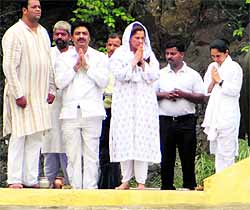
Estranged wife of Rajesh Khanna Dimple Kapadia and daugher Rinki Khanna at Rishikesh on Wednesday
Estranged wife of Rajesh Khanna Dimple Kapadia &
 daugher Rinki Khanna at Rishikesh on Wednesday.
 
Dehradun, July 25
The ashes of Superstar Rajesh Khanna were immersed in the Ganga at Rishikesh here today. Dimple Kapadia, wife of Rajesh Khanna, and their daughter Rinki Khanna reached Jolly Grant Airport, Dehradun, in afternoon, from where they headed to Rishikesh by road.
Dimple and Rinki performed the ashes immersion in a brief ceremony at Rishikesh before rushing back to Mumbai. The media was kept away from the entire ceremony. The ceremony was initially scheduled for Haridwar, but was later changed to Rishikesh to keep the crowds away. Rajesh Khanna died in Mumbai on July 18.

SC decision to ban tourism in tiger reserves hailed by wildlife conservationists


Dehradun, July 25
The Supreme Court’s decision to ban tourism in core areas of all tiger reserves in the country could not have come at a more appropriate moment for Corbett National Park, the highest tiger density park in the country. While tourism had taken a giant leap in and around Corbett, boosting the region’s economy, it's adverse ramifications on tigers have been a matter of concern among the conservationists.
In his first reactions to the apex court’s order, Uttarakhand Principal Chief Conservator of Forests RBS Rawat, while reiterating the Forest Department’s commitment towards tiger conservation, said they will await Union Environment and Forests Ministry’s directions regarding the Supreme Court order and act in it's accordance. He admitted that banning tourism in the core areas of tiger reserves will serve the large purpose of tiger conservation.
Welcoming the Supreme Court’s directive, wildlife conservationist and authority on Corbett Park Hem Singh Gehlot said the Supreme Court’s decision has come very timely. He said today tigers in the country and Corbett in particular have suffered the most in the name of eco-tourism. “Take, for example, Corbett; the resorts stand as main culprits. While on the one hand these resorts have blocked the tiger corridors, on the other they flay all norms to create trouble for the region’s wildlife, including tigers, by promoting rampant tourist activity inside the reserve,” he pointed out.
People for Animals, Uttarakhand, member-secretary Gauri Maulekhi, too, expressed her happiness over the Supreme Court’s order. She said a large tourist inflow into the core areas of Corbett Reserve is proving to be detrimental to the tiger population in the reserve.
Echoing similar sentiments, former Uttarakhand Chief Wildlife Warden AS Negi said the Supreme Court decision will certainly relieve the core zone of Corbett of increasing burden of tourists and will be in the interest of the region’s wildlife.
While conservationists have taken the Supreme court decision as a matter of rejoicing, former chairman of the State Forest and Environment Advisory Committee Anil Baluni has expressed his concern over the decision, asserting that locals, who are solely dependent on tourism in Corbett as a source of livelihood, will be the ultimate losers.
“About 20,000 people earn their livelihoods through tourism in Corbett, and the latest Supreme Court order will come as a huge setback for them,” Baluni pointed out. He said in the backdrop of the Supreme court order, he himself will be taking up the matter legally. Baluni said he would even appeal to the Uttarakhand government to take to legal course over the matter as various large and small entrepreneurs in and around Corbett will be on the verge of losing their jobs after this decision.

Victory for Doon Star, Garhwal Sporting


Players in action at the 3rd ONGC BS Negi Memorial Football Tournament in Dehradun on Wednesday

Dehradun, July 25
Doon Star and Garhwal Sporting today won their respective matches in the 3rd ONGC BS Negi Memorial Football Tournament being played at Ambedkar Stadium, Dehradun.
In the first match, Doon Star beat Doon Challengers 2-1. Balvinder scored both the goals for Doon Star, whereas Mukesh Thapa scored for Doon Challengers.
In the second match, Garhwal Sporting beat Eleven Star Football Club 5-0 in a one-sided match.
Shivam added two consecutive goals to Garhwal Sporting.
Tomorrow Uttarakhand Police will take on Garhwal Boys.

Director, Tata Sons, delivers lecture at Welham Boys' School


Dehradun, July 25
The second lecture of the Platinum Jubilee Lecture Series - Schooling Today for Tomorrow - was delivered by R. Gopalakrishnan, Director, Tata Sons Ltd, today at Welham Boys' School.
Gopalakrishnan, in his lecture, traced the historical evolution of "our left brain-oriented education system, which has reduced the ambit of teaching only to what can be taught. A shift in the approach by encouraging right-brain activities would open the possibilities to learn what cannot be taught." Beautifully woven with anecdotal and historical illustrations,
Gopalakrishnan's address held the audience enthralled as well as provoked some rather serious introspection, both internal and public.
The talk was attended by students and staff of Welham Girls' School, Rashtriya Indian Military College, as well as of Welham Boys' School.
Gopalakrishnan studied physics at Calcutta University, engineering at IIT, Kharagpur, and also attended the Advanced Management Programme at Harvard Business School.
He had served as Chairman of Unilever Arabia, as Managing Director of Brooke Bond Lipton India and finally as Vice Chairman of Hindustan Lever Limited.
The talk was followed by an intense and thought-provoking question/ answer session.