Your updated source of information about Dehradun & Uttarakhand.

Monday, March 19, 2012

CHB told to pay interest: UT Consumer Court


Chandigarh, March 19
The UT Consumer Disputes Redressal Forum has directed the Chandigarh Housing Board (CHB) to pay Rs 10,000 as compensation for causing mental agony and harassment to a local resident who had applied for a house under a scheme, but was refunded the amount after a long delay.
The complainant had moved the consumer forum, claiming interest on the amount of Rs 1.22 lakh. She was unsuccessful in the draw of lots.
The complainant, 54-year-old Chandan Lata, a Sector-23 resident, stated in the complaint that she had applied for a house under the self-financing housing scheme, 2008, for employees of the Chandigarh Administration for allotment of dwelling units.
She had paid Rs 1.22 lakh as earnest money in March, 2008. In August, 2011, she had received a letter and a cheque for Rs 1.22 lakh as refund as she was unsuccessful in the draw of lots.
It was alleged that the CHB had utilised the amount of Rs 1.22 lakh for three years and she lost the interest on the amount. She had then moved the forum, seeking interest.
In its reply, the CHB, through its chairman, stated that the complainant had given an undertaking not to claim any interest on the amount and had signed a declaration in this regard.
It was also replied that due to the pendency of litigation in the high court pertaining to the scheme under question, the draw of lots could not be held till November 4, 2010. It was stated that this had led to the delay in refund. The CHB refuted all allegations.
Passing the order, forum president PD Goel and members Rajinder Singh and Madanjit Kaur stated that it could be legitimately concluded that the CHB was under a legal obligation to refund the amount of Rs 1.22 lakh to the complainant without interest on or before December, 2010, when the draw of lots was held.
It further said the CHB refunded the amount in August, 2011, after delay and so, was liable to pay interest and compensation.
“The CHB is directed to pay interest on the amount of Rs 1.22 lakh at the savings bank rate from December 4, 2010, till payment. It id also directed to pay Rs 10,000 as compensation for mental agony and harassment, besides Rs 5,000 as costs of litigation,” read the order.

City Beautiful residents wants to impose drunk-driving penalty according to alcohol content

Chandigarh -  In future, if one commits a driving-related offence, he or she may have to shell out a fine up to five times the existing penalty. It’s a wonderful Bill, in case, implemented in order to curb the rising number of road accidents. A Bill proposing amendments to the Motor Vehicles Act, 1988, is likely to be introduced in the Rajya Sabha during the coming budget session. The Ministry of Road Transport and Highways should display the Cabinet-approved amendments adequately in newspapers, on signages and even on its website. The state police headquarters should form youth cells and rope in youngsters for night patrolling in the city.
This is the second time the Bill is being introduced in the Rajya Sabha. The previous effort was made in 2007. The UPA government is now introducing a strong Bill against traffic offenders. Hope the new law will equally apply to the top brass who generally park their red-beacon vehicles on roadsides. First, there must be a proper computerised record-keeping system interlinked throughout the country.
Computerisation will help in keeping an updated track record of all drivers which will help keep a watch on habitual offenders. Cases of drunk driving should be dealt with according to the quantity of alcohol found in the blood of an offender instead of a general law applicable to all such offenders. A person having 300 ml of alcohol in his blood should get a different punishment compared to those found with lower alcohol contents like 30 ml in their blood.
For the last over 7 years, I’ve been writing letters to the Ministry of Road Transport and Highways and many city police officials on the matter. The government and city top brass must enforce tough traffic laws in our city and no interference should be entertained.
Er Sachin Sharma, Chandigarh
Hefty fines can help check violations
These days more people die in accidents on the roads than of any diseases. The number of deaths caused by over-speeding and drunk driving is persistently on the rise as every year a large number of youngsters lose their lives in road rage. The state governments are not able to control the number of accidents through law enforcement alone and a heftier financial penalty may be a deterrent to rash and negligent driving. There is nothing wrong with the new proposal of charging huge fines as it is for the safety of people. People who are caught for violations just give a Rs 100 note to traffic cops and drive away. Nobody is afraid of this Rs 100 fine. So the amended Motor Vehicle Act is expected to bring in good results and reduce traffic violations. Anybody found drunk while driving must not be spared and suitably punished. Apart from charging hefty fines, the traffic police must ensure that checks and nakas are held on a daily basis and not only on special days. Signboards clearly indicating the permissible speed limits should be erected on roadsides.
Vineet Kapoor, Panchkula
Need to curb rash driving
Everyday a number of people are injured and killed in road accidents. These accidents occur mainly due to the negligence and carelessness of drivers, lenient traffic rules and to a large extent due to drunk driving. The move to impose hefty fines for offences like over speeding, drunk driving and using mobile while driving will help curb the menace of rash driving. It is high time that something stern and effective needs to be done.
Drunk driving, an illegal act, should be governed by stern laws which entail not only levying hefty fines or revocation of licence, but also prosecution of a violator on criminal charge. The police is ought to be more strict while enforcing traffic rules. No offender should be exempted from punishment, come what may. Also, there should be strict checking in the middle of the night when most crimes and cases of road rage occur. Different sectors, government and public, should also come forward and join hands to make the Indian roads safer. The education sector and the media can create enhanced community awareness and understanding of causes and consequences of road accidents.
Dr Shruti K Chawla, Sector-38C, Chandigarh
Step up media coverage
The aggressive media coverage of the cases of court punishment for drunken driving, which was witnessed in the city a couple of months ago, has lost steam in the recent past. The news that hit the page one consistently for some time seems to have lost its attraction.
These days drunk-driving cases are getting lesser prominence in the city newspapers. It is felt that when an offence becomes too common, it becomes less important for the Press.
The police and the media, too, need to keep addressing issues like drunk driving and this should be their top priority. Instead of just carrying pictures of the offenders in newspapers, the issue needs a wider coverage. In fact, cases of road accidents due to drunk driving needs to be highlighted.
Rakeshwar Katoch

Pinjore-Parwanoo bypass work still on

Panchkula, March 18
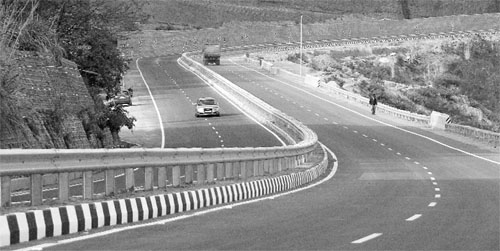
Commuters using National Highway 22 are likely to have a harrowing time for another two weeks as finishing of the 10-km Pinjore-Parwanoo bypass is still going on.
A random survey of the bypass, comprising eight bridges and four underpasses, has indicated that the centre medians on road dividers are being installed at various places.
Grills are also being installed at various places on the hilly track near Parwanoo, which will help restrict landslides during the rainy season.
The construction was started two-and-a-half-years ago. The project was supposed to be completed in December last.
The detailed project report prepared 10 years ago had to be revised as many structures had come up on the route, said an official with the construction company on the condition of anonymity.
Following this, new alignment of the road had to be devised, which also contributed to the delay in meeting the deadline, he added.
Once the bypass was thrown open, commuters would no longer be held up in traffic jams for hours at the narrow road passing through Pinjore and Kalka.
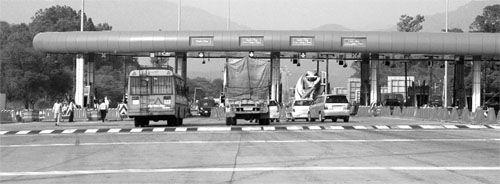
While a toll plaza had been set up at Surajpur, near Pinjore, there was also a proposal to instal CCTV cameras at the bypass.
Despite repeated attempts, NHAI Director Anil Dahiya could not be contacted as he did not respond to phone calls.
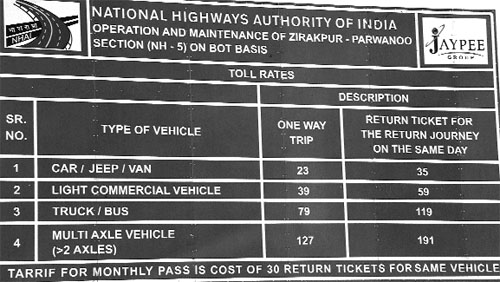
The trial run at the toll plaza had been started by the staff of the construction company. According to sources, toll would be charged from April 1.


A chart displays toll rates for vehicles.
A chart displays toll rates for vehicles. 
A view of the toll plaza on the highway.
A view of the toll plaza on the highway. Tribune Photos: Nitin Mittal
A view of the Pinjore-Parwanoo bypass.

Friday, March 16, 2012

Beatles in Dehradun


Add caption
The Beatles,India was their most creative period. When they were in Rishikesh/Dehradun for several weeks in February, March and April of 1968 (They stayed at Maharishi Mahesh Yogi's spiritual centre, Rishikesh), they wrote between 23 and 48 songs, 17 of which were included in their White Album, one of their best known.

In that period the Beatles made one song on Dehradun , which never got released. This song is treated as a rare collection on the Beatles.This song is treated as a rare collection on the Beatles. Its video has been released on the occasion of 1st Asian Mayors’ Conference, held at Dehradun, Uttaranchal, India, from Nov 26 – 28 2006, which shows clips of Dehradun our home town and essence of this blog.
Above is the links  for ' Dehradun....Dehradun' song
-----------------------------------------------------------------------------------------------------------------------------------
Circles - Written by: Harrison, Recorded: May 1968, Unreleased
George Harrison: vocals, organ

Recorded among the May 1968 demos for the White Album, Circles was a George Harrison composition which eventually saw light of day in 1982.

Upon their return from India, all four Beatles gathered at Kinfauns, Harrison's Esher bungalow. They recorded demos of 27 songs, to be put forward as potential titles for the White Album. Of these songs, 19 eventually found their way onto the album.

One of the discarded titles was Circles, seemingly recorded alone by Harrison with just an organ accompaniment. Speaking voices can be heard in the background; they may be those of the other Beatles, or possibly the sound of a television or radio.

One of Harrison's more philosophical songs, Circles is lyrically similar to The Inner Light or Within You Without You, although the concept of the changing world being observed by a stationary individual perhaps best recalls John Lennon's I'm Only Sleeping.

The Beatles never recorded Circles as a group, although Harrison's demo was later widely bootlegged along with the other Kinfauns recordings. Like Lennon's Child Of Nature - which also resurfaced in a different form some years later - Circles wasn't included on Anthology 3, although some of the other May 1968 demos did feature. 


A New Beatles Documentary in the works?

Will 2012 be the year that renowned Indian-born filmmaker Mira Nair’s documentary film about the Beatles time at Rishikesh finally gets a release?
It’s certainly a great idea for a documentary, and if anyone could pull it off it is Nair.
Known primarily for her popular and successful feature films (Salaam Bombay!, Mississippi Masala, Vanity Fair, The Namesake), she has for the past thirty years also been forging a parallel career making short films, both fiction (Migration, How Can It Be?, The Day the Mercedes Became a Hat) and documentaries (So Far from India, India Cabaret, The Laughing Club of India).
Nair has been talking about making a documentary on the connection between the Beatles and her country India since about 2006. But so far it’s failed to see the light of day. Here’s a response to a question she got about it back in 2009:
Have you ever wanted to make a documentary feature?  Yes, a feature documentary on the Beatles in India. The Beatles wrote twenty-three songs when they went to the Maharishi’s ashram in 1968. And I think the impact of India on the Beatles and vice versa would make for a very cool film. I went to the ashram myself and photographed it—it’s all abandoned. I made a very evocative photo portrait of what is there now. So I mixed that with archival footage and made a twenty-minute piece, to let the producers preview it. The producers couldn’t get the rights to the songs, but we have to keep trying. One day I really hope to do it.  (from The Criterion Collection)
Things have been a bit quiet since, but could the recent focus on George Harrison and his spiritual journey be a new catalyst? The Martin Scorsese documentary “Living In The Material World” certainly has the influence of India on George as a central theme….
I got an email from fellow blogger Beatlindia quoting another 2009 article which appeared in the Sunday Pioneer newspaper in New Delhi. That article has since been republished elsewhere on the web, prompting speculation that Mira Nair’s film may be closer than we think:
Renowned film director Mira Nair is making a film on The Beatles and their inspirational stay at Rishikesh to learn transcendental meditation. The 90-minute “docu-feature” will capture the band’s experiences at the Maharishi Mahesh Yogi’s ashram, which led many celebrities and youngsters to travel to the East in search of peace.
Rishikesh lies in the Doon Valley in the foothills of the Himalayas, some 200 kilometres from the Indian capital of New Delhi. It’s just near the city of Dehradun, which is the subject of a song written by George Harrison and recorded by the Beatles – but never released. Sharad Kukreti, a Doon Valley-based IT professional, produced a short video film using the song as the soundtrack to various sights and scenes of the city:
The article continues:
For the Beatles, their stay in India was said to be their most creative period. When they were in Rishikesh (for several weeks in February, March and April of 1968), they wrote many songs, most of which were included in their White Album, one of their best known. “Dehra Dun” missed getting included in the album. This song is seen now as a rare gem of the Beatles. With their iconic long hair and necklaces of marigolds, The Beatles came to the ashram when they were at the height of their fame. They were looking for an escape from the pressures that came along with the fame. “It was through one of my neighbours that I could get this rare song,” says Kukreti. The video made by Kukreti matches the words of the songs and captures the beauty and tranquility of the valley. However, it is this beauty and calm that the city is fast losing and one wonders whether the Beatles could have been inspired to write a song had they visited it in this day and age. “The song captures the past simplicity of the valley and is very special for Doon’ites, especially those who have seen the days when the Beatles came here,” Kukreti says. He has placed the clip on the net and has received a lot of appreciation for it. “The nostalgia in this song and the fact that it was sung by Harrison makes it unique and I feel it should be highlighted more,” he says.
I hope Mira Nair keeps plugging away at her film project.


Sachin Tendulkar becomes first to score 100 international centuries


Indian cricketer Sachin Tendulkar bats on his way to scoring a century during the Asia Cup cricket match against Bangladesh in Dhaka, Bangladesh, Friday, March 16, 2012. Tendulkar, who had been stuck on 99 centuries for a year, became the first cricketer to score 100 international centuries on Friday when he hit to square leg and ran a single against Bangladesh in the Asia Cup. (AP Photo/Aijaz Rahi)
Indian cricketer Sachin Tendulkar bats on his way to scoring a century during the Asia Cup cricket match against Bangladesh in Dhaka, Bangladesh, Friday, March 16, 2012. Tendulkar, who had been stuck on 99 centuries for a year, became the first cricketer to score 100 international centuries on Friday when he hit to square leg and ran a single against Bangladesh in the Asia Cup.  
 
DHAKA: India's Sachin Tendulkar on Friday became the first batsman in history to score 100 international centuries, adding another milestone in his record-breaking career.

Tendulkar, who turns 39 next month, achieved the feat when he recorded his 49th one-day century in the Asia Cup match against Bangladesh at the Sher-e-Bangla stadium in Dhaka. He has 51 Test hundreds.

The Mumbai batsman, who has compiled more Test and one-day runs than anyone in history, reached the record with a single, marking the moment with a modest glance to the sky while pointing to the Indian flag on his helmet.

Tendulkar is the most capped player in the history of the game with 188 Test and 462 one-day appearances since making his debut against Pakistan in Karachi in November, 1989.

Millions of fans in India and across the cricketing world endured an anxious year-long wait before Tendulkar finally reached the landmark in the four-nation tournament, the symbol of one-day supremacy in the continent.

He scored his 99th ton during a World Cup match against South Africa in Nagpur on March 12 last year, but failed to add to the tally on subsequent tours of England and Australia and a home series against the West Indies.

Former Australian captain Ricky Ponting is the second batsman on the all-time list with 71 international centuries. 

Over thousand Gurdwaras around the world celebrate 2nd Sikh Environment Day

Today is the anniversary of Guru Har Raibecoming the seventh Guru of the Sikhs (this type of anniversary is called a Gurpurab)  in 1644.  Among the aspects of his legacy that Sikhs remember today was this Guru’s love for the natural world.

19th century painting of Guru Har Rai (photo: sikhfoundation.org)

19th century painting of Guru Har Rai
Washington : As many as 1007 Sikh institutions and gurdwaras around the world celebrated March 14, the day nature and animal lover Guru Har Rai became the seventh Sikh Guru in 1644, as Sikh Environment Day.

EcoSikh, a Washington based Sikh organization, which had initiated the celebrations last year had set the goal of enrolling more than 700 Sikh institutions and gurdwaras to celebrate the day this year as compared to 450 last year.
This year it had also included Sikh run schools and Sikh-owned businesses to join in this endeavour.
Dr. Rajwant Singh, president of EcoSikh said: "It is amazing to see so much enthusiasm among Sikh masses and we believe that is perhaps the largest direct action by the Sikhs for the environment ever in the history.
"Guru Har Rai's life has inspired so many individuals to lead efforts at the local levels in India and all across the globe to take meaningful actions dedicated to this day."
Bandana Kaur, New York based programme director of EcoSikh in North America, said: "Many Gurdwaras are engaging in the local environmental issues in North America in their own localities and many are becoming eco-friendly in their operations."
Scores of young people are excited about this effort since it gives them the opportunity to relate to their faith in a unique way. South Hall based largest gurdwara in Europe has organized a major green drive on this day."
Sri Akal Takhat Sahib and Takhat Hazur Sahib in Nanded, Maharasthra, and Sikhs in several countries including USA, Australia, Canada, China, Singapore, Malaysia, Argentina, Nigeria, Kenya and UK joined in the effort to mark the Sikh Environment Day as a tribute to Guru Har Rai, EcoSikh said.

Traffic police launch drive to penalise offenders


Haridwar, March 15
In view of the large number of accident cases, particularly due to overloading, not wearing helmet and usage of cellular phones while driving, the city police has now started a drive in this regard.
Apart from imposition of penalty and seizing of vehicles, the traffic police is also along side carrying awareness drive among the vehicle riders.
Superintendent of Traffic Police Kiran Lal Shah told TNS that taking into account past two years’ accident cases in the city zone, most of them have occurred due to rash driving, overloading and not following traffic rules.
“As a result the police has now decided to penalise offenders, challan vehicles and even impound them if they violate again the traffic rules,” said Shah.
Autorickshaws which ferry more than stipulated passengers or are seen in prohibited routes and zones are also being booked by traffic police personnel. This drive has created fear among the traffic violators as traffic personnel are deployed at major intersections, highways and congested markets to ensure violators don’t roam freely.
Teenagers, particularly school students, who are found riding without helmets or are carrying more than one pillion rider, are being given stern warning initially taking into consideration the examination season. Such offenders’ parents are also being informed so that they know the risk their children are creating themselves. Kanika Bahuguna, a Ranipur resident, whose college-going daughter was penalised by traffic personnel as she was not wearing a helmet and talking on mobile while driving and ferrying two other girls on a single scooty, appreciated the ongoing traffic drive.
She urged police personnel to inform youngsters’ parents immediately when they catch them as otherwise they don’t come to know of the violation of traffic rules by their children easily.